The 2026 rookie RB class enters the league with a wide range of fantasy outcomes, making landing spot, opportunity, and draft capital more important than ever when evaluating these prospects. While there may not be multiple clear cut elite prospects, several rookie RBs landed in situations that could create immediate fantasy relevance and long term dynasty value.
This breakdown covers the top ten rookie RBs selected in the 2026 NFL Draft. Each player is profiled with physical measurables, draft capital, and prospect evaluation to paint a realistic fantasy football outlook using the FFA weighted PPR projections and average ADPs. The goal is to identify where the market may be too high or too low on certain rookie RBs, while highlighting which players have the clearest paths to fantasy production entering year one.
If you missed our full 2025 class recap, check out my 2025 Rookie Projection Post-Season Analysis and 2025 Pre-Season Rookie RB article for a deeper look at last year’s rookie landscape and how RBs compare year to year.
Become an FFA Insider today to gain access to our projections HERE and more on how they are calculated HERE. Average ADPs from CBS, ESPN, FFC, MLF, NFL, RTS, and Yahoo.
Round One Backs:
Jeremiah Love 6’0 212 (3rd AZ / RB1)
FFA PPR Projection: 251 FPTS / RB13
FFA AVG ADP: 37th / Keep Trade Cut (KTC): 15th / RB4 / Underdog: 25th / RB13
Love is the highest RB taken in the draft since Saquon Barkley went #2 overall in 2018, and the hype is fully warranted. He posted a 4.36 second 40 yard dash (2nd/10 RBs) at the combine, possessing elite speed and agility for a player his size. In his final college season, Love posted 199 carries for 1,372 rushing yards at 6.9 yards per carry with 18 rushing TDs, adding 27 receptions for 280 yards and three receiving scores. He set Notre Dame’s total TD record with 21, surpassing Hall of Famer Jerome Bettis, and was the 2025 Doak Walker Award winner (CFB’s top RB). During his two years as the starter at Notre Dame, he combined for 40 total TDs and averaged 6.9 yards per carry each season. Love is 21 years old and after sharing the backfield with fellow first round pick Jadarian Price, he only incurred 496 touches through three seasons with a ton of tread left on his tires.
Love joins a Cardinals team that ranked 31st in rushing yards per game last season (93.1), behind a restructured offensive line. The Cardinals signed Tyler Allgeier to a two year deal this offseason and restructured James Conner’s contract to keep the veteran in Arizona. 2024 third round pick Trey Benson also remains on the roster. The backfield is crowded on paper, but no one expects those veterans to hold Love back from the top of the depth chart. New HC Mike LaFleur has made clear that explosive plays are central to his offensive philosophy, and Love fits that mold better than any back in this class. LaFleur’s play action and motion heavy scheme from his Rams OC tenure should create space for Love to thrive.
With Trey McBride, Marvin Harrison Jr. and Michael Wilson already in place, Arizona suddenly has one of the highest ceiling offensive skill position groups in the NFC. Love’s arrival will make an immediate impact to the backfield and provide a versatile weapon to use in the passing game. He is the clear cut RB1 in this class and carries workhorse potential from day one.
Jadarian Price 5’11 203 (32nd SEA / RB2)
FFA PPR Projection: 172 FPTS / RB32
FFA AVG ADP: 77th / Keep Trade Cut (KTC): 75th / RB18 / Underdog: 63rd / RB26
Price gives Seattle a compact runner who clocked an official 4.49 40 yard dash (7th/10 RBs) at the NFL Combine and was the second Irish back taken in the first round. In his final season at Notre Dame, Price recorded 113 carries for 674 yards and 11 TDs, adding just 6 receptions for 87 yards. Price averaged 6 YPC and forced 73 missed tackles on 281 carries over his three seasons. Context matters, his raw production numbers are modest playing in the shadow of one of the highest drafted RBs in recent history. He produced 24 runs of 10+ yards in 2025 and is a smooth mover with elite vision to contour run lane spacing.
Price could slot in as the immediate starting RB for the Seahawks who successfully leaned on their run game throughout 2025. Super Bowl MVP Ken Walker III left in free agency for Kansas City, and Zach Charbonnet tore his ACL during the divisional round, putting his 2026 season in significant doubt. The path to volume could not be clearer as the team only brought in Emanuel Wilson on a one year deal as competition. The concerns stem from the passing game, receiving a 27 PFF pass block grade along with a -2.1 average depth of target (ADOT) on just 7 targets in 2025. This limited sample size signals most of his targets came well behind the line of scrimmage and could provide limited third down value without improvement.
If Price develops as a receiver and pass blocker, this could be one of the class’s most rewarding dynasty investments. He has first round capital, a wide open starting job, and a fantasy friendly offense coming off a Super Bowl run. The floor is real, but the ceiling hinges on how quickly he can become a three down contributor, and less of a contributor to a committee.
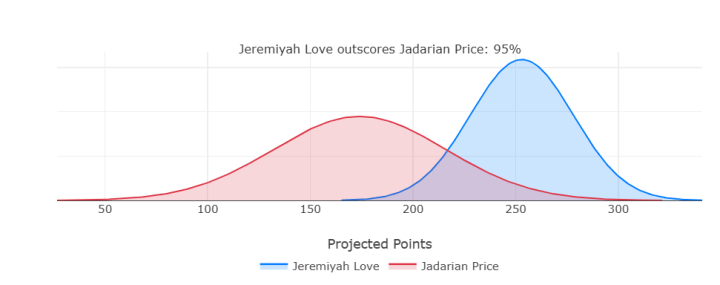
The graphs below are available in our projections using the compare players feature.

Distribution: Each curve is a player’s projected-points range (their average ± the standard deviation of analyst projections). A wider curve means more uncertainty; where two curves overlap, the players are close. When exactly two players are selected, the figure at the top is the modeled probability that one outscores the other.

Radar: Each axis — Points, Floor, Ceiling, VOR, Consistency — is scaled 0–100 relative to other players at the same position. A larger shaded area means a stronger all-around profile versus positional peers.
Round Three:
Kaelon Black 5’10 210 (90th SF / RB3)
FFA PPR Projection: 50.3 FPTS / RB79
FFA AVG ADP: 192nd / Keep Trade Cut (KTC): 270th / RB72 / Underdog: 214th / RB69
Since Christian McCaffrey joined the team in 2022, the 49ers have drafted Jordan James, Isaac Guerrendo, Tyrion Davis-Price and Trey Sermon in 2021. Kaelon Black looks to break the mold, drafted in round three with a 4.46 40 yard dash and a 10’5” broad jump from his pro day. His path to this point has been anything but conventional. Black completed a six year collegiate career at James Madison and Indiana, totaling 2,692 rushing yards, 488 receiving yards, and 23 total TDs. In his second season at Indiana, he led the national champion Hoosiers with 10 rushing TDs and posted 1,034 rushing yards in 2025, splitting time with an undrafted Roman Hemby, who had 1,118 rushing yards of his own.
Black’s age (24.6) is a legitimate concern, making him just four days younger than 2023 84th overall pick De’Von Achane. His production against top competition remains impressive in the new transfer portal era of college football. He showed scouts his aggressive running style, ability to finish through contact, and consistent forward momentum, running with strong hips and a fall forward mentality that grinds out extra yards.
Kyle Shanahan publicly defended selecting Black in the third round, stating that the 49ers had him as the RB2 on their entire board. This speaks volumes about how this organization evaluated him, however the landing spot comes with major caveats. Shanahan’s track record with RBs selected in round three or later since 2017 has been shaky, to go along with joining a room still led by Christian McCaffrey. Similar to Jadarian Price, Black comes with third down question marks, posting only 9 receptions for 48 yards during his time at Indiana. This came after 44 receptions and 440 yards on 52 targets in three seasons at JMU, showing his ability to contribute.
The fantasy community should be wary of the hype premium that comes with a 49ers RB. Black’s ceiling in year one as a handcuff and rotational piece is real, but the opportunity for standalone value is solely dependent on McCaffrey’s health. A wait and see approach is warranted before overinvesting here.
Round Four:
Jonah Coleman 5’8 220 (108th DEN / RB4)
FFA PPR Projection: 45 FPTS / RB86
FFA AVG ADP: 154th / Keep Trade Cut (KTC): 140th / RB34 / Underdog 155th / RB47
Coleman started his college career at Arizona before transferring to Washington, and the Broncos drafted him 108th overall in the fourth round. Coleman rushed for 758 yards and 15 TDs while averaging 4.8 YPC in 12 games in 2025. He also recorded 31 receptions for 346 yards and 2 TDs, slightly boosting his PPR appeal. He is sure handed, recording 551 carries across his college career and fumbling only twice. Coleman is a compact and densely built ball carrier who runs downhill with physicality and power. He wins with patience, has craftiness to let his blocks set up and contact balance to make it difficult for defenders to bring him down with arm tackles. One knock on Coleman’s profile is no 40 time from his pro day or combine, we won’t have an idea of how he will look in an NFL open field until it actually happens.
Coleman joins a RB room in Denver that already includes J.K. Dobbins and RJ Harvey, making this a crowded situation entering 2026. Dobbins is the established veteran, returning on a two year deal and Harvey burst onto the scene as a second round pick in 2025 with Sean Payton’s strong endorsement. However, the selection of Coleman suggests Denver was not satisfied. He could immediately change the RB room by pushing for short yardage work and third down reps. His developing receiving ability and stout pass protection (3 sacks allowed over 4 seasons) give him the profile of an every down back if either Dobbins or Harvey stumbles. The Broncos are a legitimate Super Bowl contender heading into 2026 following an AFC Championship appearance, meaning this offense will be productive but touches will be earned and hard to come by.
Mike Washington Jr. 6’1 223 (122nd LV / RB5)
FFA PPR Projection: 71 FPTS / RB61
FFA AVG ADP: 181st / Keep Trade Cut (KTC): 231st / RB57 / Underdog: 200th / RB60
Washington is the kind of late round dart with a measurables profile that makes scouts sit up straight. He ran a 4.33 40 yard dash, which ranked 1st/10 RBs and 9th among all players at the NFL Combine. He also recorded a broad jump of 10’8”, and a vertical jump of 39”, which were both second among RBs. The production backed it up. Following three years at Buffalo and one at New Mexico State, Washington transferred to Arkansas for his final season. He was named All SEC Second Team after starting all 12 games and rushing 167 times for 1,066 yards at 6.4 yards per carry with 8 TDs, while catching 28 passes for 226 yards. Washington’s journey is itself a testament to persistence, recording over 3,357 total yards during his college career.
With little to no depth behind Ashton Jeanty heading into the draft, adding to the RB room was a priority for the Raiders, and they traded up in the fourth round to land Washington. The obvious ceiling here is a high upside handcuff or compliment to Jeanty in a Klint Kubiak zone running scheme that should fit Washington’s speed and lateral agility. The floor is rotational work behind a star ball carrier who will absorb the bulk of the workload. Washington has breakaway speed in the open field but can be a step slow to see hole open and go. A key spot for improvement is running with greater confidence and aggression as he makes the NFL transition. Washington’s elite athleticism keeps him one Jeanty injury from being a must start asset in all formats without any additions to the backfield.
Round Five:
Emmett Johnson 5’10 202 (161st KC / RB6)
FFA PPR Projection: 43.7 FPTS / RB90
FFA AVG ADP: 177th / Keep Trade Cut (KTC): 199th / RB51 / Underdog: 191st / RB56
Johnson was among the most productive players in all of college football last year, leading the Big Ten with 1,450 rushing yards and adding 15 total TDs. He was also 1/5 RBs to average at least 120 rushing yards per game in 2025. He clocked a 4.56 second 40 yard dash at the combine, finishing last out of 10 RBs. This may have hurt his draft stock, with scouts looking to see elite athleticism to pair with an impressive film profile. His receiving game is a genuine plus, adding 46 receptions for 370 yards with a 1 ADOT. His tape shows vision and elusiveness to navigate at the line effectively in man and gap schemes, suiting him well for the versatile KC offense.
The Kansas City landing spot is both intriguing and complicated. This is one of the most consistently elite offenses in the NFL under Andy Reid that just brought in Ken Walker III on a three year deal. Johnson likely enters the rotation as a complementary piece, with an exact role to be determined during training camp. Day three draft capital keeps expectations tempered, but the Chiefs’ track record of developing contributors across the roster combined with Johnson’s versatility makes him a late dynasty stash worth monitoring for a potential emerging role.
Nicholas Singleton 6’0 219 (165th TEN / RB7)
FFA PPR Projection: 25.2 FPTS / RB111
FFA AVG ADP: 173rd / Keep Trade Cut (KTC): 164th / RB41 / Underdog: 208th / RB63
Singleton ran for 3,451 yards and 45 rushing TDs across four college seasons, setting a Penn State record with 5,586 all purpose yards. He also caught 102 passes for 986 yards and 9 TDs in his career. His freshman year in Happy Valley was a takeover, rushing for 1,057 yards and winning Big Ten Freshman of the Year. The issue is what happened in 2025. His production was cut in half while the Penn State program fell off the rails and HC James Franklin was fired mid season. Singleton also sustained a broken foot at the Senior Bowl that prevented him from working out at the combine, almost certainly hurting his draft position sigificantly. His vision as a runner needs to take a big leap, but his early breakout, receiving ability and special teams upside offers a high ceiling.
Singleton rounds out an established Tennessee backfield that includes Tony Pollard, Tyjae Spears, and free agent addition Michael Carter. The crowded room limits his year one ceiling as a fantasy option, but Singleton is the only Titans RB under contract for 2027. If his health is confirmed before training camp and his vision improves in an NFL system, Singleton has the athletic traits and receiving versatility to carve out a big role. His dynasty profile is essentially a buy low player whose pedigree is excellent, but whose cost is manageable due to late round capital and crowded situation.
Adam Randall 6’3 232 (174th BAL / RB8)
FFA PPR Projection: 45.5 FPTS / RB84
FFA AVG ADP: 177th / Keep Trade Cut (KTC): 360th / RB93 / Underdog: 215th / RB76
Randall is one of the most unique prospects in this class, a former four star WR once nicknamed “Baby Julio” who made a permanent switch to RB heading into 2025. Randall spent his first years at Clemson as a WR, before Dabo Swinney asked him to switch positions the day after his electric 41 yard kick return to set up a game winning drive in the 2024 ACC Championship. The transition was seamless, he rushed for 809 yards and scored 10 TDs on 168 carries in 2025, while adding 36 receptions for 250 yards and 3 TDs. At 232 pounds, Randall clocked a 4.5 second 40 yard dash at the combine (8th/10 RBs). Ravens GM Eric DeCosta called Randall a “jackknife”, his varied skillset could well in a role similar to Cordarrelle Patterson. He also added that “RBs with his size, speed and route skill are rare” and they believe “the best is yet to come with him as a RB.”
Like Derrick Henry, Randall cuts an imposing figure, a potential thunderous complement with potential to be the incumbent as Henry enters his age 32 season. This is a dynasty development play in an efficient and run heavy offense centered around Lamar Jackson. While his physical profile mirrors Henry, his natural skill set is more aligned with a receiving back and could push for the third down role with a few improvements. The concerns are real, his pass protection technique is lacking and drops plagued him during his WR days, following him to the backfield with 6 drops on 49 targets in 2025.
Ravens owner Steve Bisciotti reportedly pushed hard for Randall as his first personal selection since buying majority ownership in 2004, but he still enters the league with only one full season of experience at RB. Given the opportunity ahead of him in Baltimore and tantalizing size + speed profile, Randall is worth a late stash in dynasty formats while he develops.
Round Six:
Kaytron Allen 5’11 216 (187th WAS / RB9)
FFA PPR Projection: 24 FPTS / RB110
FFA AVG ADP: 182nd / Keep Trade Cut (KTC): 207th / RB53 / Underdog: 203rd / RB61
Allen was a four year contributor at Penn State and Third Team All-American in 2025. He rushed for 4,167 yards and 39 TDs in his career, leaving as the Nittany Lions’ all time leading rusher and averaging 5.4 yards per carry. In his final season, Allen posted 6.2 YPC with 1,303 yards and 15 TDs on 220 carries.
Allen did not run at the combine, and his sixth round draft capital reflected a limited receiving profile and modest overall upside more than a flaw as a runner. He never topped 20 receptions or 130 receiving yards in a season and ranked last among combine RBs in yards per route run. At his best, Allen projects as a physical early down and short yardage back capable of handling volume between the tackles, but without much proven value in the passing game.
Washington’s depth chart currently reads: Jacory Croskey-Merritt, Rachaad White, Jerome Ford, and Kaytron Allen. The upside is more situational than talent based, but still real. This is a QB friendly, efficient offense under a healthy Jayden Daniels, and Allen could bring the reliable short yardage and goal line skillset the Commanders currently lack. Washington’s assistant GM Lance Newmark specifically highlighted Allen’s pile pushing ability and noted he’s “a really good short yardage player”. He won’t be a fantasy starter to start 2026, but if he develops into the goal line option for an offense just two years removed from an NFC Championship appearance, the TD driven value could make him worth a waiver wire add in redraft leagues if the opportunities arise.
Demond Claiborne 5’10 188 (198th MIN / RB10)
FFA PPR Projection: 30 FPTS / RB104
FFA AVG ADP: 182nd / Keep Trade Cut 260th / RB68 / Underdog 213th / RB67
Claiborne measured in at 5’10 and 188 pounds at the combine, adding to his resume with a 4.37 40 yard dash (3rd/10 RBs) and a 10’2” broad jump (6th/11 RBs). His college career at Wake Forest showed consistent improvement year over year. He totaled 559 carries for 2,605 yards and 26 TDs over his collegiate career. He also contributed to special teams as a returner, returning 2 kickoffs for TDs. The 2024 season marked his full arrival, 229 carries for 1,053 yards and 13 total TDs, becoming the first Demon Deacon to rush for 1,000 yards since 2018. He followed that up with 907 rushing yards and 10 TDs in 2025, cementing himself as the clear lead back in the offense.
There are some interesting parallels between Claiborne and De’Von Achane as prospects entering the league. Achane measured at 5’8, 188 pounds and ran a 4.32 at the combine before earning third round draft capital after posting consecutive 900+ yard seasons at Texas A&M. Like Claiborne, Achane entered the NFL with strong receiving efficiency, finishing his college career with 65 catches for 554 yards compared to Claiborne’s 55 catches for 424 yards. The situations are also comparable, with Achane entering a Miami backfield led by aging veterans Raheem Mostert and Jeff Wilson Jr., while Claiborne joins a Minnesota room featuring 31 year old Aaron Jones and Jordan Mason. The difference is draft capital, as Achane entered the league after his junior year with significantly stronger third round NFL investment and a more explosive profile overa
Minnesota badly needed to add speed and explosiveness after ranking 10th last in rushing YPG last season. They have been looking for a back who offers the home run speed and explosion that has been missing since the prime of Dalvin Cook. He projects as a change of pace back to provide a new dimension to the Minnesota offense, particularly in a backfield that already features more traditional runners. Both Mason’s and Jones’ contracts expire after 2026, opening a real door for Claiborne to grow into a larger role by 2027. His 4.37 speed is legitimate, and Kevin O’Connell’s offense has historically featured creative usage for speedy backs. At this price and draft position, Claiborne is the kind of flier worth taking with your last pick in dynasty rookie drafts. He’s a player whose athletic profile and landing spot trajectory give him RB2 upside down the road even if he carves out a limited role as a rookie.

Stay Connected with FFA:
For more data-driven fantasy football analysis and projections, follow us on social media:
- X (Twitter): @FFAnalyticsNet
- Facebook: FFAnalytics
- Instagram: @fantasyfootballanalytics
Visit FantasyFootballAnalytics.net for our latest tools and articles.
The post 2026 Rookie RB Roundup appeared first on Fantasy Football Analytics.