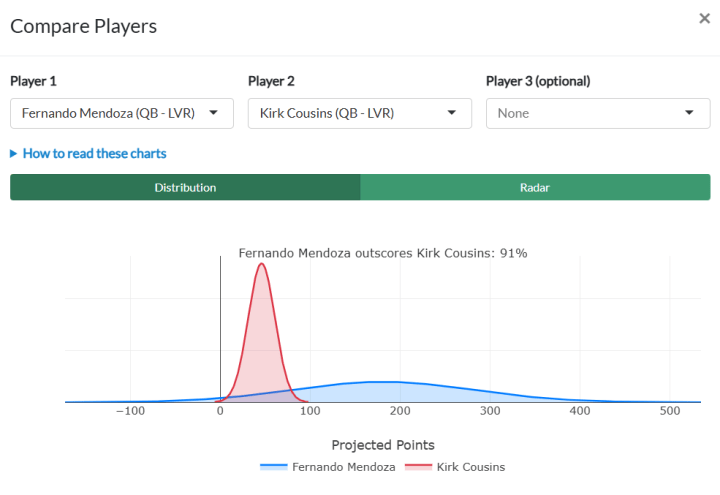
The 2026 rookie class enters the league with a wide range of fantasy outcomes, making landing spot, opportunity, and draft capital more important than ever when evaluating these prospects. While there may not be multiple clear cut elite fantasy football options, several rookies landed in situations that could create immediate relevance and long term dynasty value.
This is the final breakdown of my three part series, covering the top five rookie QBs and top ten TEs selected in the 2026 NFL Draft. Each player is profiled with physical measurables, draft capital and prospect evaluation to paint a realistic fantasy football outlook using the FFA weighted PPR projections and average ADPs. The goal is to identify where the market may be too high or too low on certain rookies, while highlighting which players have the clearest paths to fantasy production entering year one.
If you missed our full 2025 class recap, check out the 2025 Rookie Projection Post-Season Analysis and our 2025 Pre-Season Rookie QB/TE article for a deeper look at last year’s rookie landscape and how incoming players compare year to year.
Become an FFA Insider today to gain access to our projections HERE and more on how they are calculated HERE. Average ADPs from CBS, ESPN, FFC, MLF, NFL, RTS, and Yahoo.
First Round QBs:
Fernando Mendoza 6’4 236 (1st LV / QB1)
FFA 6 Points Per Passing TD (6PPTD) Projection: 181 FPTS / QB31
FFA AVG ADP: 139th / Keep Trade Cut (KTC): 54th / QB14 / Underdog: 191st / QB29
Indiana’s Fernando Mendoza was clearly the most complete player at the position. He led the Hoosiers to an undefeated 16-0 season and the College Football Playoff national title, throwing for 3,536 yards, 41 TDs, and just 6 INTs while adding 377 rushing yards and 7 rushing TDs. He won the Heisman Trophy with a 88.4 QBR that ranked third in the nation. In the College Football Playoff alone, he recorded an 8:0 TD-to-INT ratio. He excels as a quick processor, making decisive decisions with a mind beyond his years. He began his career at Cal as a 3-star recruit in 2022 and remade himself into the consensus QB1 in a single season at Indiana.
The Fernando Mendoza era in Las Vegas has officially arrived. GM John Spytek called him “a great person, raised the right way, great family — it’s about his team, it’s about winning, it’s about doing the right thing.” Las Vegas already has Brock Bowers and Ashton Jeanty in place as two key weapons for Mendoza early in his career. They further invested, adding WR Jalen Nailor and C Tyler Linderbaum but the Raiders will have to continue upgrading their supporting cast to have him anywhere near as comfortable as he was at Indiana. As it stands, the Raiders do not have a WR with more than 57 receptions in a season (Tre Tucker in ’25).
While Kirk Cousins has been named the Week 1 starter, Mendoza’s dynasty outlook is clear as the QB1 in this class and long term investment. His year one outlook hinges on when the Raiders feel compelled to play him, but some of the cornerstone weapons are already in place for him to succeed on day one.


Ty Simpson 6’1 211 (13th LAR / QB2)
FFA 6PPTD Projection: 26 FPTS / QB41
FFA AVG ADP: 170th / KTC: 109th / QB27 / Underdog: 216th / QB42
Simpson completed 64.6% of his passes for 3,561 yards, 28 TDs, and 5 INTs in 2025, helping Alabama clinch a College Football Playoff birth. Over the first eight games he threw 18 TDs to 1 INT. He struggled down the stretch as defenses dialed up pressure, in the final six games he threw 8 TDs to 4 INTs and had a string of inconsistent performances. Simpson flashed potential to be an NFL starting quarterback with a savvy, polished skill set. His dropbacks are rhythmic and well timed with route concepts. The concerns are real, he often waits for his target to complete their breaks and will stare down a receiver if he tries to predetermine too much. These will create turnover worthy situations that veteran defenders will exploit at a higher level.
Following one season of starting experience, the Rams selected Simpson 13th overall with the pick obtained from Atlanta in 2025. Matthew Stafford is coming off an MVP season and worked out an extension this summer, seemingly taking things year by year. McVay made it clear that this is still Stafford’s team and they believe Simpson gives them a piece to develop for the years after his retirement. Simpson is a high floor, low ceiling player who will be a competent starting QB at his best and mediocre backup at worst. He makes enough plays off platform and has good enough wheels to warrant a first round selection. Unlikely to see the field as a rookie, the hope is this is the right coaching staff to bring him along after just one season as a starter in college.
Third and Fourth Round QBs:
Carson Beck 6’5 233 (65th AZ / QB3)
FFA 6PPTD Projection: 34 FPTS / QB37
FFA AVG ADP: 183rd / KTC: 174th / QB29 / Underdog: 215th / QB36
In his first and final season at Miami, Beck completed an ACC leading 72.1% of his throws for 3,813 yards and 30 TDs to 12 INTs during the Hurricanes’ national championship run. Before his time in Miami, Beck spent five years with the Georgia Bulldogs where he threw for 7,883 yards and 57 TDs to 20 INTs on 70% passing. His most notable improvement in 2025 was processing speed, moving through progressions quickly and playing with greater confidence and decisiveness. His journey to this point was anything but straightforward. Following a 2024 season at Georgia that ended with a UCL tear to his throwing arm during the SEC Championship, Beck reversed a declaration for the 2025 draft and entered the transfer portal. His arm is reliable for big time throws when on time, but there are plenty of moments where he puts the ball in harms way. He also brings little mobility with just 591 career rushing yards, offering a small margin for error if the pocket collapses.
After parting with former first overall pick Kyler Murray, Arizona lacks a long term solution at QB. Beck represents a developmental project who might develop quicker than the average Day 2 pick given his extensive collegiate experience and high pressure performances. He enters with competition from veterans Jacoby Brissett and Gardner Minshew, which will give him a path to year one playing time. Beck was among the QB prospects the Cardinals hosted for top 30 visits this draft cycle and the organization clearly has a strong belief in him. His value is purely a long term play, if the decision making holds up in Mike LaFleur’s system around a loaded skill group that just added Jeremiyah Love third overall, he could emerge as a legitimate starter. The bust risk is real for a six year collegiate player turning 24 in November, but the experience is undeniable. Beck will be ready to seize the opportunity when it comes, a similar situation to second year Saints QB Tyler Shough who turns 27 in September.
Drew Allar 6’5 228 (76th PIT / QB4)
FFA 6PPTD Projection: 11 FPTS / QB75
FFA AVG ADP: 183rd / KTC: 198th / QB31 / Underdog: 216th / QB42
Allar appeared in 45 games for Penn State, completing 633 passes for 7,398 yards and 61 TDs across four seasons for the Nittany Lions. He is a physically gifted QB with high upside and ceiling at 6’5, with a natural throwing ability and arm talent to execute every throw in the book. He has traditional and ideal size to sit in the pocket and survey the field, flashing anticipation to get the ball out early and beat coverage. There are concerns about his decision making considering how much experience he has, suffering a lower body injury in Week 7 against Northwestern that ended his 2025 season prematurely.
Allar joins a QB room that has officially kept four QBs on the 53 man roster, including Aaron Rodgers, second year Will Howard and Mason Rudolph. Returning Steelers QB coach Tom Arth has spoken positively about Allar and his potential to develop inside the AFC North. Comparisons to Joe Flacco and Ryan Tannehill are fair, a big bodied, big armed QB who needs the right infrastructure to maximize his potential. He is a pure stash in Pittsburgh, but has a legitimate ceiling if the Steelers commit to developing him as a starting competitor heading into 2027.
Cade Klubnik 6’2 207 (110th NYJ / QB5)
FFA 6PPTD Projection: 8 FPTS / QB73
FFA AVG ADP: N/A / KTC: 269th / QB39 / Underdog: 216th / QB42
Klubnik started 12 games for Clemson in 2025, completing a career best 65.2% of his passes for 2,946 yards with 16 TDs and 6 INTs. In 2024, he set personal bests with 3,642 yards passing and 36 TDs against just 6 INTs. Across his Clemson career, he appeared in 49 games, rushing for 1,378 yards and 17 TDs. Klubnik showcased straight line speed at his pro day, clocking a reported 4.58-4.65 40 yard dash time. He is a mobile, rhythm driven passer who excels in spread systems that utilize RPO and play action concepts. His concerns are inconsistent decision making on true dropbacks and a tendency to feel pressure too soon when the pocket compresses.
The Jets traded up 18 spots to add Klubnik to a QB room led by Geno Smith. He will be a project for offensive coordinator Frank Reich, with an opportunity to learn behind Geno and potentially earn the backup role. They invested heavily early in the draft, adding two first round picks Kenyon Sadiq and Omar Cooper to go along with Breece Hall and Garrett Wilson. Klubnik is another depth stash who could be thrusted into a starting role mid season, but the Jets’ investment to move up and get him is a good signal that his development will be treated seriously in New York.
Top Two TEs:
Kenyon Sadiq 6’3 241 (16th NYJ / TE1)
FFA PPR Projection: 109 FPTS / TE23
FFA AVG ADP: 155th / KTC: 111th / TE9 / Underdog: 180th / TE24
Sadiq is one of the fastest TEs ever to run at the NFL Combine. He ran a 4.39 40 (1st/18 TEs) which is the fastest by a TE in combine history, following it up with the second highest vertical jump at 43.5” (2nd/18 TEs). The production backed those numbers up. In 2025 he caught 51/67 targets for 560 receiving yards, and his 8 TDs ranked first among FBS TEs. His athletic profile translates naturally to the passing game, projecting as a weapon on seam routes, crossers, and vertical concepts that pressure linebackers and safeties. The 4.39 speed creates matchup problems down the field, possessing a burst and explosiveness to generate YAC and separate in space. The only legitimate knock is production context. He spent most of his first two seasons behind Terrance Ferguson, limiting his opportunities. His career receiving totals are less impressive than one would hope. Even so, the combination of elite athletic traits, proven receiving production, and untapped upside gives him one of the highest ceilings in the class.
The Jets’ selection came as a slight surprise, with Makai Lemon still on the board. Pairing him with 2025 second rounder Mason Taylor gives New York the ability to use creative two TE sets under new OC Frank Reich. The Jets secured a premium pass catcher at 16th overall and Sadiq immediately becomes the most explosive TE on the roster. His dynasty upside is elite, a 4.39 speed TE taken top 16 in the draft is a rare commodity. The offense with Garrett Wilson, Breece Hall, Omar Cooper, and a retooled line around Geno Smith gives him the infrastructure to produce from day one.
Sadiq has been dealing with a hernia issue this offseason and is expected to be ready for Week 1. His upside will ultimately hinge on how the Jets distribute personnel and if he quickly earns a full time route share. Even if the offense isn’t efficient or explosive, Sadiq’s role can still be stable because of how he wins. He doesn’t need sustained drives to matter, just designed touches and some red zone involvement.
Eli Stowers 6’4 239 (54th PHI / TE2)
FFA PPR Projection: 70 FPTS / TE36
FFA AVG ADP: 160th / KTC: 150th / TE14 / Underdog: 214th / TE42
Stowers may have the single most remarkable athletic testing performance in this entire class at 6’4 239. He ran a 4.51 40 (2/18 TEs), and set TE combine records in both the broad jump (11’3”) and the vertical jump (45.5”). His path through college football is unlike most prospects, the former 4 star high school QB started at Texas A&M before transferring to New Mexico State and then landing at Vanderbilt. He had two big seasons at Vanderbilt. 50 catches for 644 yards and 5 TDs in 2024, then 62 catches for 769 yards and 4 TDs in 2025, winning the John Mackey Award as the nation’s outstanding TE. Over 70% of his college snaps came in the slot, where he showcased ability win as a receiver and create mismatches. He is not a traditional in-line TE who projects as a dominant blocker at the next level, but his elite athleticism gives him the potential to become a dynamic receiving weapon.
The Eagles kicked off the 2026 draft by trading up to select WR Makai Lemon at 20 before doubling back to take Stowers at 54. Stowers joins Philadelphia as the organization looks to find the long term successor to Dallas Goedert while reshaping an offense that recently moved on from A.J. Brown. His NFL ceiling is Kyle Pitts lite, a receiver first TE with elite athleticism and big play ability after the catch. Stowers finished second among TEs in the class with 377 YAC, showcasing the explosiveness that makes his profile so intriguing.
Despite the second round selection, Stowers has also dealt with injuries during camp and could reportedly be a healthy scratch after being sidelined for a significant portion of the offseason. The opportunity is there to become one of the highest upside investments in the class for dynasty managers willing to be patient, but he still has to earn trust in a role behind Goedert.
Second Round TEs:
Nate Boerkircher 6’4 245 (56th JAX / TE3)
FFA PPR Projection: 43 FPTS / TE57
FFA AVG ADP: N/A / KTC: N/A / Underdog: 216th / TE51
Boerkircher is a unique second round project at the position. Coming into the NFL as a blocking first TE, he has more in the tank as a route runner than you might expect. His finishers mentality lines up blocks on the move with accuracy and knocks defenders off their feet. Boerkircher played 2020-2024 at Nebraska and 2025 at Texas A&M. catching 38 career passes for 417 yards and 4 TDs, including 19 for 198 yards and 3 TDs in 2025. He caught the game winning TD in a massive road win over Notre Dame in the CFP quarterfinal, putting him on the national map. He measured 6’5 and 245 pounds, with his only movement combine metric being a 4.4 shuttle. This is not a receiving threat by the metrics, but he showed enough athleticism to intrigue Jacksonville at 56 overall.
Nobody will be high on Boerkircher in year one fantasy wise due to a limited production profile, and that’s the honest assessment. His release and ability to be physical quickly are the attributes that made Jacksonville commit to him, and a blocking first TE can be a starter in the modern NFL. Even from a dynasty perspective, the path to fantasy relevance is difficult with Brenton Strange already ahead of him and signing an extension through 2029. Boerkircher can be viewed as a guy to monitor rather than a priority rookie add. Allow time for his receiving ability to develop before expecting meaningful target share, his value will come from earning consistent snaps and long term development similar to Seahawks TE AJ Barner.
Marlin Klein 6’6 248 (59th HOU / TE4)
FFA PPR Projection: 68 FPTS / TE38
FFA AVG ADP: N/A / KTC: 372nd / TE53 / Underdog: 216th / TE51
Born in Cologne, Germany, Klein played his first two years of American football with the Cologne Crocodiles before relocating to Georgia and committing to Michigan. He is one of the most unique origin stories in this class. Klein had the best campaign of his modest career in 2025, grabbing 24 receptions for 248 yards and 1 TD in 11 games as the replacement for first round pick Colston Loveland. At 6’6 and 248 pounds, his 4.61 40 (7th/18 TEs), 36” vertical (9th/18 TEs), and 9’9” broad jump (16th/18 TEs) turned heads at the NFL Combine. The profile is one of extraordinary upside and limited evidence of production, only 12 career starts and 38 catches. The NFL already values Klein for his blocking, but his athletic ability and reliable hands give him the tools to develop into a more complete TE.
Houston entered the draft with a minor position of need at TE with Dalton Schultz turning 30 and entering the final years of his contract. Klein projects as a blocking first TE who can develop a complementary receiving skillset as he gains more NFL experience. Coming from a blue blood program like Michigan, Klein has been developed in a pro-style environment and brings a strong foundation to the NFL. The bet is purely developmental behind Schultz in the short term, and that Klein’s combination of size and speed could eventually produce a starting caliber TE. His immediate fantasy impact is limited, but the athletic profile and long term fit in a CJ Stroud led offense give him a path to gaining dynasty value quickly.


Max Klare 6’4 246 (61st LAR / TE5)
FFA PPR Projection: 29 FPTS / TE80
FFA AVG ADP: 170th / KTC: 243rd / TE31 / Underdog: 216th / TE63
Klare transferred from Purdue to Ohio State for his final season in 2025. His career receiving line across the two Big Ten programs totals 116 receptions for 1,328 yards and 6 TDs. At Ohio State, he recorded 43 receptions for 448 yards and 2 TDs in 2025, earning First-Team All-Big Ten honors. In Purdue’s 1-11 2024 campaign, he put up a team leading 51 catches for 684 yards and 4 TDs before electing to transfer. He projects as a dependable, high floor TE whose value comes from efficiency, feel, and YAC ability rather than vertical explosiveness. This archetype is best suited for a McVay style play action heavy offense, featuring creative delayed releases, crossers, and stick concepts.
The selection Klare with the 61st pick marks back to back years in which Los Angeles has taken a TE in round two. Klare lands in a crowded TE room including 2025 second round pick Terrance Ferguson, Colby Parkinson, and Tyler Higbee. He is a mid range TE at best with a shot at low end TE1 upside long term. Sean McVay’s offense historically uses multiple TEs efficiently, scheming targets and production in the intermediate game. The competition with Ferguson will define his dynasty trajectory, if either separate from that battle by 2027 they could genuinely have an elite role in one of the league’s best offenses. Klare is worth following during training camp, but Ferguson’s path serves as a reminder to temper expectations for rookie TEs.
Sleeper TEs:
Oscar Delp 6’5 245 (73rd NO / TE7)
FFA PPR Projection: N/A
FFA AVG ADP: N/A / KTC: 262nd / TE37 / Underdog: 216th / TE51
A former four star recruit regarded as the nation’s top high school TE prospect, Delp totaled 70 receptions for 854 yards and 9 TDs over a four year career at Georgia. His modest raw totals are a product of starting his career behind Brock Bowers and Darnell Washington, then being joined by Lawson Luckie in one of college football’s best recent TE rooms. Delp played the entire 2025 season without knowing he had a hairline fracture, which was discovered during pre-combine testing. A tough blow for a guy hoping to showcase his athletic profile, but he was still able to turn heads at Georgia’s pro day with a reported 4.49 40 and a 38” vertical. Pro day numbers, not combine verified, but a rough idea of his numbers. He showed glimpses of his athleticism every year but never put it together over an extended stretch of games.
The Saints have veteran Juwan Johnson under contract through 2027 and Noah Fant for extra depth. This will likely limit Delp’s playing time as a rookie, but the offense around Tyler Shough is one of the more intriguing young NFC units. With Tyson, Olave, Etienne, Kamara, and now Delp all in the mix, HC Kellan Moore has assembled a supporting cast for his developing QB. The dynasty buy is a bet that there is talent Georgia never unlocked. If he earns a larger role over time, his athletic profile gives him a path to outperform his draft capital, but year one expectations should remain measured.
Will Kacmarek 6’5 261 (87th MIA / TE8)
FFA PPR Projection: 42 FPTS / TE62
FFA AVG ADP: 170th / KTC: N/A / Underdog: 216th / TE63
Kacmarek measures 6’5 and 261 pounds, the second heaviest TE in this entire class, running a 4.74 40 (17th/18 TEs) with a 36” vertical (7th/18 TEs) at the combine. He transferred from Ohio University to Ohio State, winning a National Championship and becoming one of the best blocking TEs in this nation. His receiving profile is thin, limited looks in a stacked Buckeyes offense, but his physical tools suggest he can be more as an NFL player. While evaluators may consider his round three selection a reach at first glance, the Dolphins clearly prioritized adding the blocking profile to a shallow room. This pick should help rebuild their offensive identity around Malik Willis and De’Von Achane.
Even in a shallow depth chart with only Greg Dulcich, Kacmarek’s fantasy ceiling is limited in Year 1. His value will likely come from his blocking ability and potential long term role within the offense rather than immediate target volume. He is a player to roster and monitor in dynasty formats. If he earns a significant snap share early in his career and develops a consistent role in the passing game, he could gain value as a potential streaming option in redraft leagues. If not, the initial investment is low enough that dropping him carries minimal cost.
Eli Raridon 6’6 245 (95th NE / TE9)
FFA PPR Projection: 39 FPTS / TE66
FFA AVG ADP: 197th / KTC: 216th / TE26 / Underdog: 215th / TE37
Raridon measures 6’6 and 245 pounds with a 4.62 40 (10th/18 TEs), 10’3” broad (5th/18 TEs) and a 36” vertical (10th/18 TEs) at the combine. Projects as a “Y” TE with the ability to play and produce on all three downs. In the pros, he might spend more time with his hand in the ground than he did at Notre Dame, blocking with solid technique and good tenacity while still needing to add muscle mass to his long frame. It is also worth noting that he suffered two ACL tears in the same knee during his career. Despite failing to produce over 100 receiving yards in a single season, Raridon broke out in his senior year, recording 32 receptions for 482 yards and 0 TDs.
Raridon posted a 2.33 YPPR mark last season (3rd/27 combine TEs) highlighting the efficiency and receiving upside that was not fully reflected in his raw career totals. His ability to threaten vertically is an underrated part of his profile given his size and athletic testing. He joins New England as a developmental option behind Hunter Henry, who is set to hit free agency after the 2026 season. This creates an intriguing opportunity in Drake Maye’s offense if Raridon can establish himself as a reliable receiving option in year one.
Matthew Hibner 6’4 251 (133rd BAL / TE10)
FFA PPR Projection: 28 FPTS / TE86
FFA AVG ADP: N/A / KTC: 385th / TE57 / Underdog: 216th / TE49
Hibner measured 6’4 and 251 pounds at the combine with a 4.57 40 (5th/18 TEs), a 37” vertical (4th/18 TEs), and an impressive 28 bench press reps (1st/9 TEs). He is a Michigan national championship product with little playing time who transferred to SMU for his final two seasons. In 2025, Hibner posted 31 receptions for 436 yards and 4 TDs, setting career highs across the board. His totals across Michigan and SMU stand at 57 receptions for 819 yards and 8 TDs. Coming from Michigan he has a physical, compact blocking skillset with reliable hands, though his ability to consistently separate remains the biggest question mark.
Baltimore’s offense has consistently valued TEs who can contribute as blockers while creating opportunities in the passing game. With Isaiah Likely, Charlie Kolar, and Patrick Ricard departing this offseason, there is an opportunity for younger players to earn a role. Hibner joins a TE room where he can develop behind veteran Mark Andrews while competing with fifth round pick Josh Cuevas.


The post 2026 Rookie QB/TE Projection Evaluations appeared first on Fantasy Football Analytics.